

Into the breach
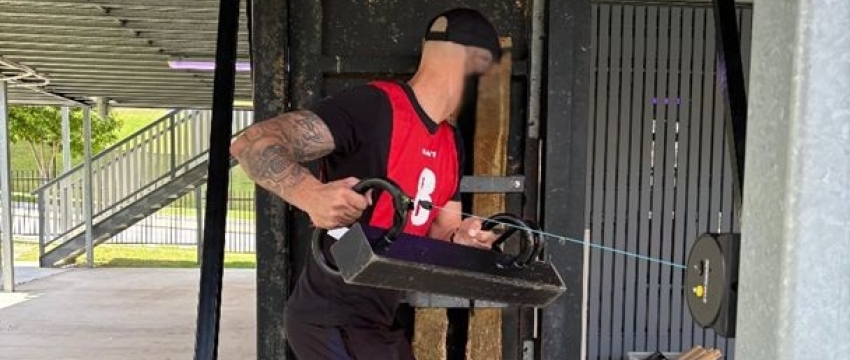
Breaching looks simple, until you measure it.
Dynamic entry is one of those tasks that feels intuitive to operators: fast, violent, and over in seconds. But despite its importance, we’ve never actually known how much power a breach requires. So we set out to quantify it.
Using a GymAware linear transducer attached to a 15 kg ram and a 5.11 breaching door, we captured the power output produced during strikes against inserts (“chocks”) that simulate increasing door resistance. Across the cohort, breaching generated:
1 chock: 2987.4 ± 467.0 W
2 chocks: 3014.2 ± 589.7 W
3 chocks: 3297.4 ± 657.3 W
To put that into context, these outputs are equivalent to the explosive power produced in a 33–34 cm vertical jump (for ~3000 W) and a 38–39 cm vertical jump (for ~3300 W), based on the Sayers equation. In other words, breaching sits squarely in the high‑power, alactic domain, the same physiological profile we see in VJ performance, dead‑ball throws, and the initial phase of casualty drags.
To our knowledge, this is the first dataset to quantify breaching power output in a real‑world policing context. And that matters, because it finally gives us something we’ve never had before: A measurable benchmark for training.
Instead of guessing what “operationally ready” looks like, we can now anchor power development to actual task demands. It informs:
- threshold targets for explosive power,
- return‑to‑work criteria,
- selection standards,
- and conditioning programs that genuinely reflect the job.
Breaching will always be a high‑stakes, high‑power action. Now we can train for it with precision.